Stay Tuned!

Subscribe to our newsletter to get our newest Blogs instantly!

Travel Destination

Jantar Mantar ! Astronomical piece of Art, Scientific and Awesome Observations

Jantar Mantar

Jantar Mantar is basically known as a cluster of instruments for mathematical calculation. This is a Sanskrit term, and it is derived from the word Yantra. It is known as a machine, while Mantra is known as a calculation. The beauty of Jantar Mantar today is to see how, in ancient times, astronomical observations predicted the weather. 

Hence, in the 18th century, a king decided to build these instruments, which are actually humongous and scientifically an amazing piece of work.

Rajputs always believed in doing things for their people. So King Sawai Jai Singh planned and executed Jantar Mantar. There are 5 astronomical observation instruments in total. 
It’s also recognised as a UNESCO World Heritage Site. The best one, besides other cities, is in the pink city called Jaipur in India. 
 
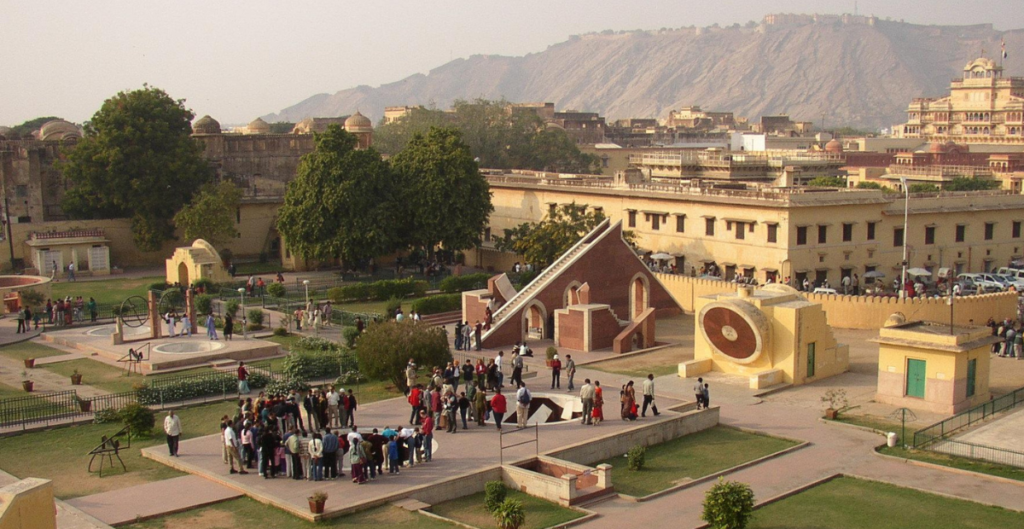
It has the world’s largest stone sundial, and it can surprisingly measure local time. So you actually can stand right there, look at the sundial, and figure things out by observing and guessing. Can you believe it can accurately tell you the local time by just 2 seconds? That’s so cool in the digital world to explore such an ancient piece of art. 
 
You won’t even need something special to read it; just your naked eyes are enough. 
Far ahead of the new tech and telescope, this was a massive structure used to observe astronomical readings. Also, in those times, the maps of the solar system were read, and they could also track eclipses and guess celestial details with a naked eye. It’s called the Samrat Yantra, which is like 90feet and more than 27 meters high. 
This is not done just here, but it also has The Rashivalaya Yantra that’s unique and has 12 instruments that align with the zodiac sign to track the correct positions of the heavenly bodies for astrology and calendar purposes. 
 
Lots of people from the world of mathematics were astonished to see these instruments, which used mathematics to get those readings and how precise they can be. These are highly calculated devices. 
 
 
Jantar Mantar
The first is in Jaipur, and it has 12 unique instruments and architectural marvels, from Rashivalaya yantras to the Sundial. For this, visit Jaipur. 
In New Delhi, you will get to see another astronomical observatory structure, also called the Jantar Mantar.
 
It was built in the 1724 by Maharaja Jai Singh 2. 
It has 13 architectural structures. 
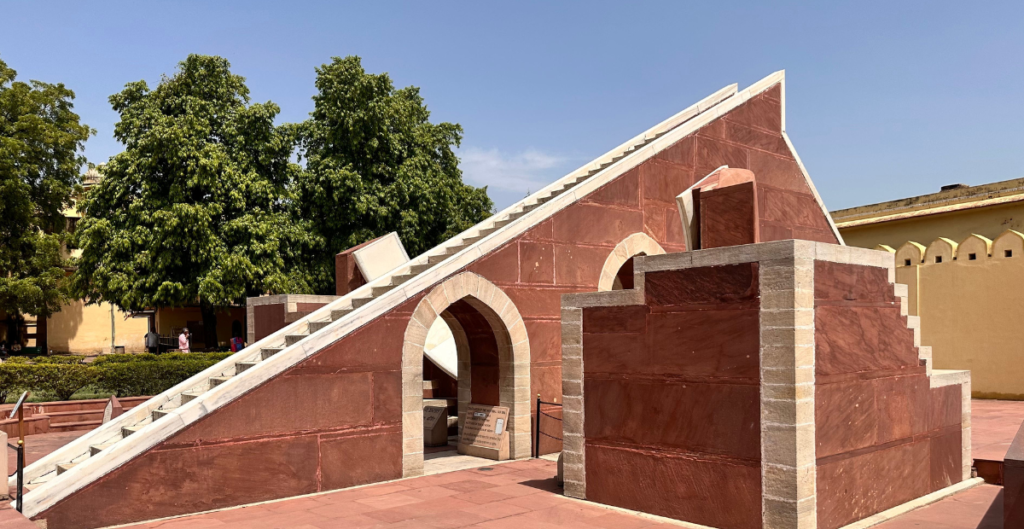
Samrat Yantra, which is a sundial to measure local time. It is 27 meters tall. 
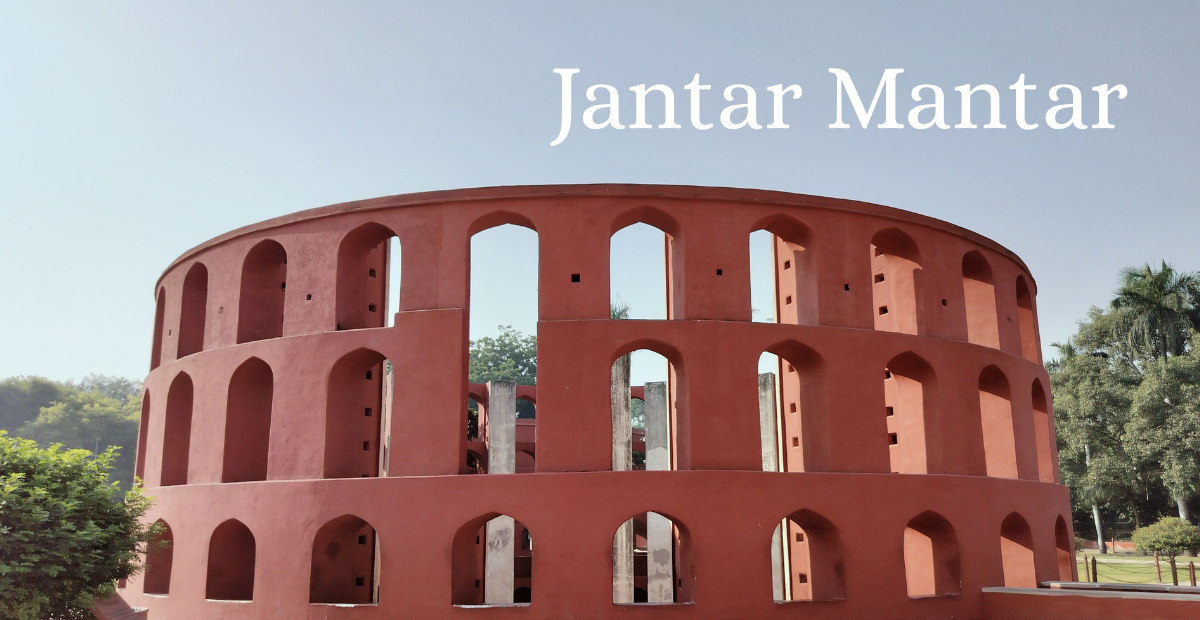
The Rama Yantra here is an open-air building and is circular. 
It’s quite large and two in number. It measures the altitude and azimuth of celestial objects. It also has the Jai Prakash Yantra, which is a conclave and has bowl markers with maps and shows the position of the stars and the sun. The Misra Yantra is a different and unique structure as it combines 4 instruments, and it determines the shortest and longest days of the year. 
You will definitely need a local guide to help you understand these yantras and make the observations. 
 
Jantar Mantar Ujjain. It is also known as Vedh shala and is again an anciently built astrological site with Observatory instruments. It was built in 1725 by Maharaja Jai Singh. It is active even today for its celestial studies. Can you believe it’s India’s prime meridian, and it is situated near the Tropic of Cancer? 
The Surya Siddhanta was calculated here in Ujjain, and it’s the ancient hub for classic astronomical texts to be written. It was again renovated in the 1923 by Maharaja Madhav Rao.  Here you will get to see the Samrat Yantra, again a huge sundial to measure local time and see the celestial altitude. Nadi Valaya Yantra shows the sun’s position in the north and south hemispheres. Digamsha Yantra measures the Azimuth and angles of celestial bodies.  The Shanku Yantra is used to measure time, shadow lengths, and sun declination. 
 
Head towards Varanasi and you will get to another similar Jantar Mantar called the Man Mahal Observatory. Here, you can also track the celestial bodies, measure local time, and study eclipses. It was again built by the same Maharaja on the rooftop of Man Mahal Palace.
It is close to the River Ganga near the Dashashwamedh Ghat. It has some main core instruments called the Samrat Yantra, Digamsa Yantra, Chakra Yantra, and Daksinottara Bhitti Yantra.
You can also visit the ground floor, which has some exhibits and panels from the ASI, meaning the Archaeological Survey of India. 

Jantar Mantar Mathura

It was built between 1711 and 1725. It was the earliest and was made before all other Jantar Mantars. It was designed to track solar and lunar movements, which helped in predicting eclipses and creating astronomical tables. It was built here due to its historical and cultural significance, and it is also a prominent center of North India. 

Is Jantar Mantar used today?

Due to the growth and development over the years, Jantar Mantar is no longer used to predict or as an active site for astronomical research. It is Popular as a tourist attraction, with school visits, historic monuments, and museums. 
 
You must have definitely heard of the recent protest by students in New Delhi at Jantar Mantar. Yes, so the Jantar Mantar in New Delhi is used for public demonstrations and political protests, just like Azad Maidan in Mumbai.
 It is also used for scientific and educational purposes.
But mostly now it is a spot for Civic activism.
 
Then it was banned in 1993 from holding any rallies inside, but the streets surrounding the Delhi Jantar Mantar are now officially used by citizens for raising voice grievances. 
There are several rules and accessibility restrictions to be strictly regulated. 
Avatar

Team IV

About Author

Leave a comment

Your email address will not be published. Required fields are marked *

You may also like

Travel Destination

“Mandav (Mandu) – Ancient Fort City of Madhya Pradesh | Afghan Architecture & Heritage”

There are many variations of passages of Lorem Ipsum available but the majority have suffered alteration in that some injected
Patalpani waterfall
Travel Destination

“Exploring Patalpani Waterfall – A Thrilling Marvel Near Indore”  

There are many variations of passages of Lorem Ipsum available but the majority have suffered alteration in that some injected